Tenth Post
Why Sideways? (And where's the Ninth Post??)

A grace-filled Roman Feast of Our Lord's Sacred Heart and Byzantine Feast of the Martyr Bishop Nicholas Charnetsky & Others and the Venerable Father Sampson, y'all!
First, a bit o’ housekeeping: I mistakenly labeled the Eighth Post the Seventh Post bc I'd forgotten that there already was a Seventh Post. So, what's labeled Eighth is really Ninth…y'all get the drill, so here we are at the correct numeration. 😃
Our perspective affects how we take in a data set and how we interpret it, and that interpretation will lead us down one train of thought to a set of conclusions, while the missed perspective and its conclusions will be hidden from us.
OK, looking a this shape…
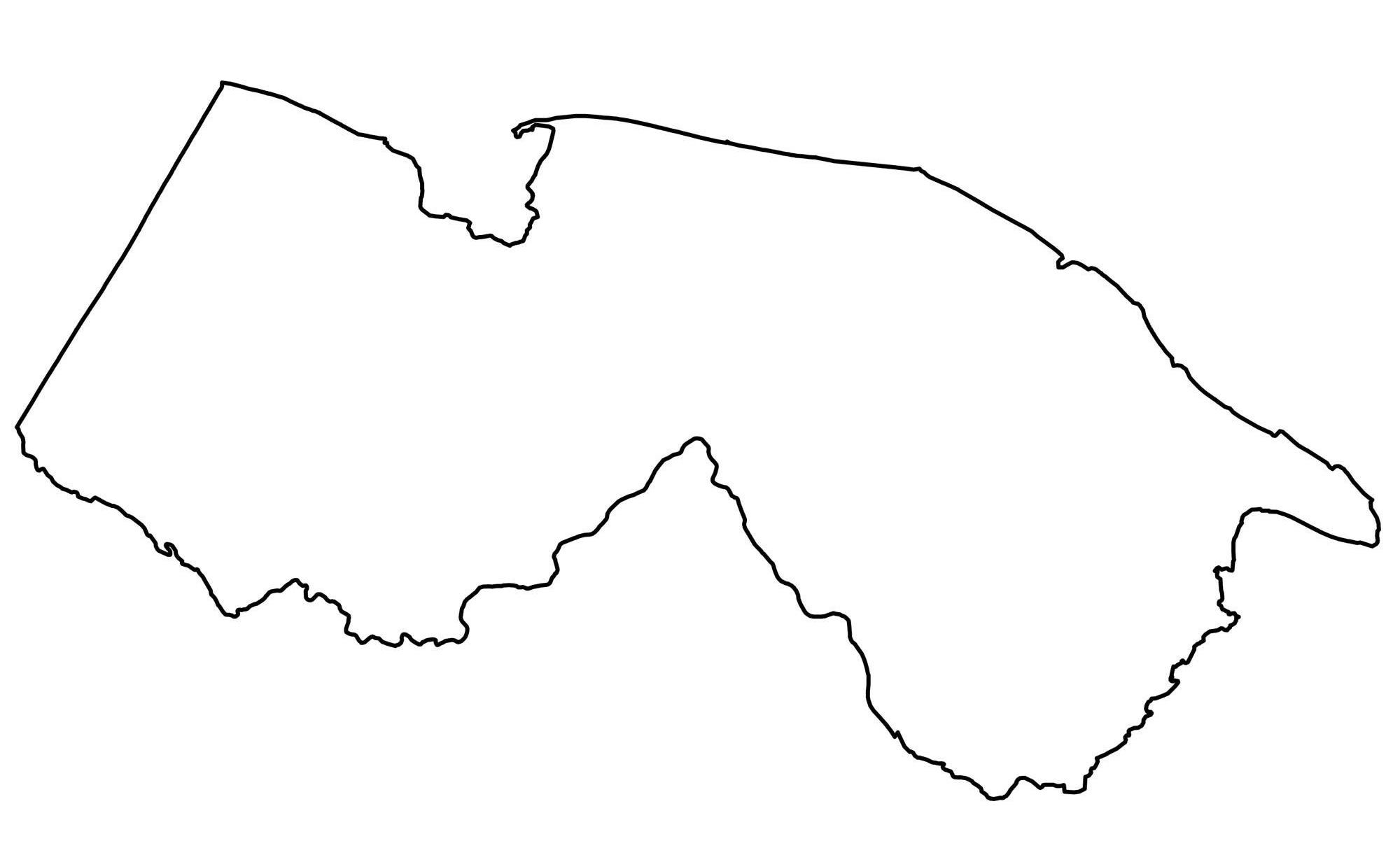
…we see:
— a convulsing buffalo?
— my toddler nephew's sketch of Fido, the family pug?
— a square hamburger bun run over by a bicycle?
— my dog ate my homework?
— a private cay in the Exumas of the Bahamas?
Hint: Sandy Hook, Raritan Bay, Cape May Peninsula…
YES, it's Joisey…I mean…New Jersey!
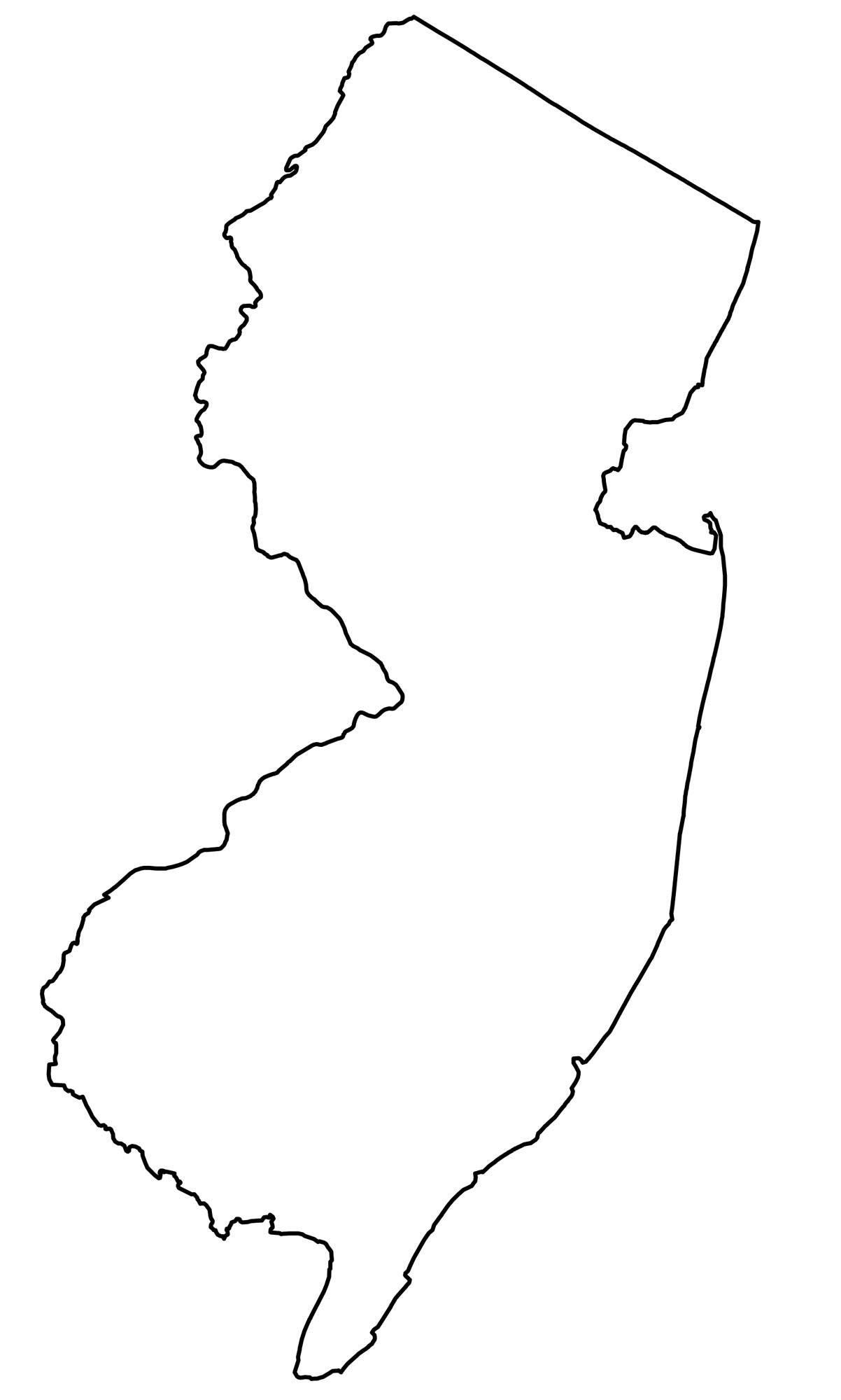
(Original outline from https://gisgeography.com/wp-content/uploads/2020/03/New-Jersey-Outline-Map.jpg)
Our perspective often determines what we see. This holds especially true for maps, where we've all been conditioned from childhood to see every map with North at the top, and thus every geographical feature aligned only North-South. For navigation purposes, the convenience of this convention far outweighs the benefits another perspective would provide. However, for other purposes, alternate perspectives would be very useful. To wit, let's look at a map of the World Ocean Floor…
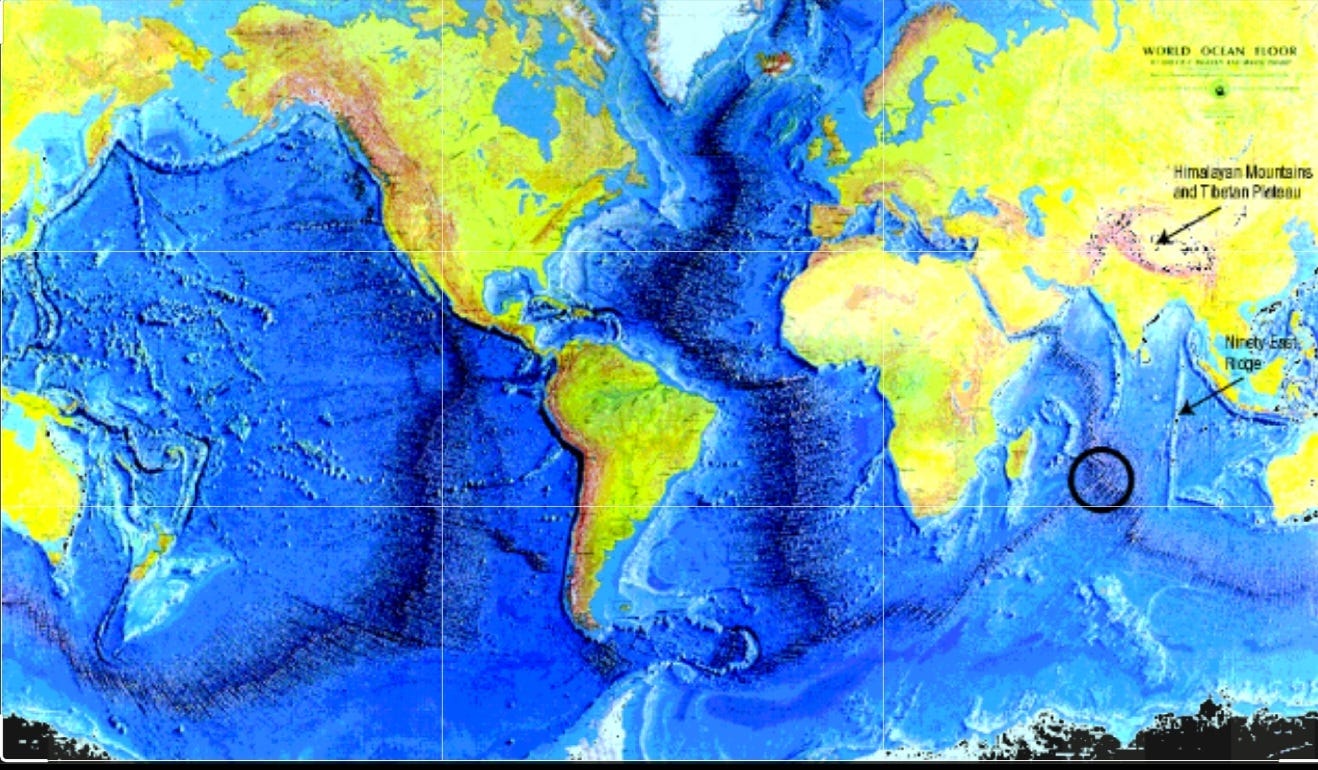
(From: https://www.creationscience.com/onlinebook/HydroplateOverview2.html, specifically https://www.creationscience.com/onlinebook/images/hydroplateoverview-tharp_world_ocean_floor_map12.gif)
…it's the configuration and orientation we're all familiar with: North at the top. (It's easy to forget, though, that the Earth is a sphere while the map is flat, so the features of its spherical surface need to be projected onto a flat plane, in this projection, everything around the equator being normal size while all else getting disproportionately large as you go toward the poles, making Greenland, Alaska, and Northern Siberia far larger than they actually are. 😀)
Looking at the Atlantic Ocean in particular, we see a familiar jigsaw fit between Africa and South America, and even kinda-sorta between North America and Europe. It's what inspired the Theory of Plate Tectonics: continents drift. The location of a lot of the mountain ranges (brown color) makes subduction zones of that Theory plausible.
Now let's turn things sideways…
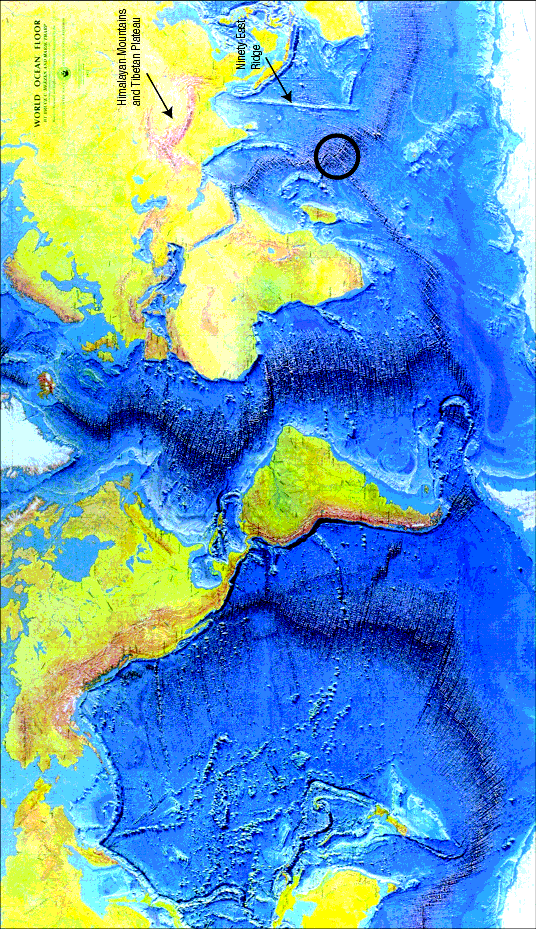
…focusing on South America. Shrinking the Antarctic end of South America to match the tropical end scale, look at the island arcs at either end: the Caribbean and the South Sandwich Islands running from the Tierra del Fuego to the Palmer Peninsula of Antarctica. What do you see?
I see:
— the swirls waist-deep water makes when I slowly walk through it, and
— the swirly piles of dust that are left on two sides when a broom sweeps through a pile of dust wider than the broom, and
— the wrinkles that a tablecloth develops when you push it in the middle with one hand.
Now, look at the LONG mountain Range running from Southern Alaska over to the Tierra del Fuego.
In a normal map configuration, it's a really amazing feature!
In this sideways configuration, it makes me think of:
— a slippery-bottomed throw rug sliding on a floor until its front end snags on something and wrinkles up.
SOOO, ponder what happened? And how quickly? My observations and ponderings suggest sliding…quickly.
Also (Homework!! 🙄), rotate the map around to varying degrees and ponder how the other mountain ranges formed.
Our Mother of Perpetual Help, aid us!!
Ademar