
Glory to Jesus Christ, y'all on this beautiful Byzantine Feast of Sts. Joachim and Anna, the parents of Our Lady, and very patient because they waited so long for this precious child: their only! (In Byzantine custom, a Feast Day is immediately followed by a smaller Feast Day of the secondary personages involved.)
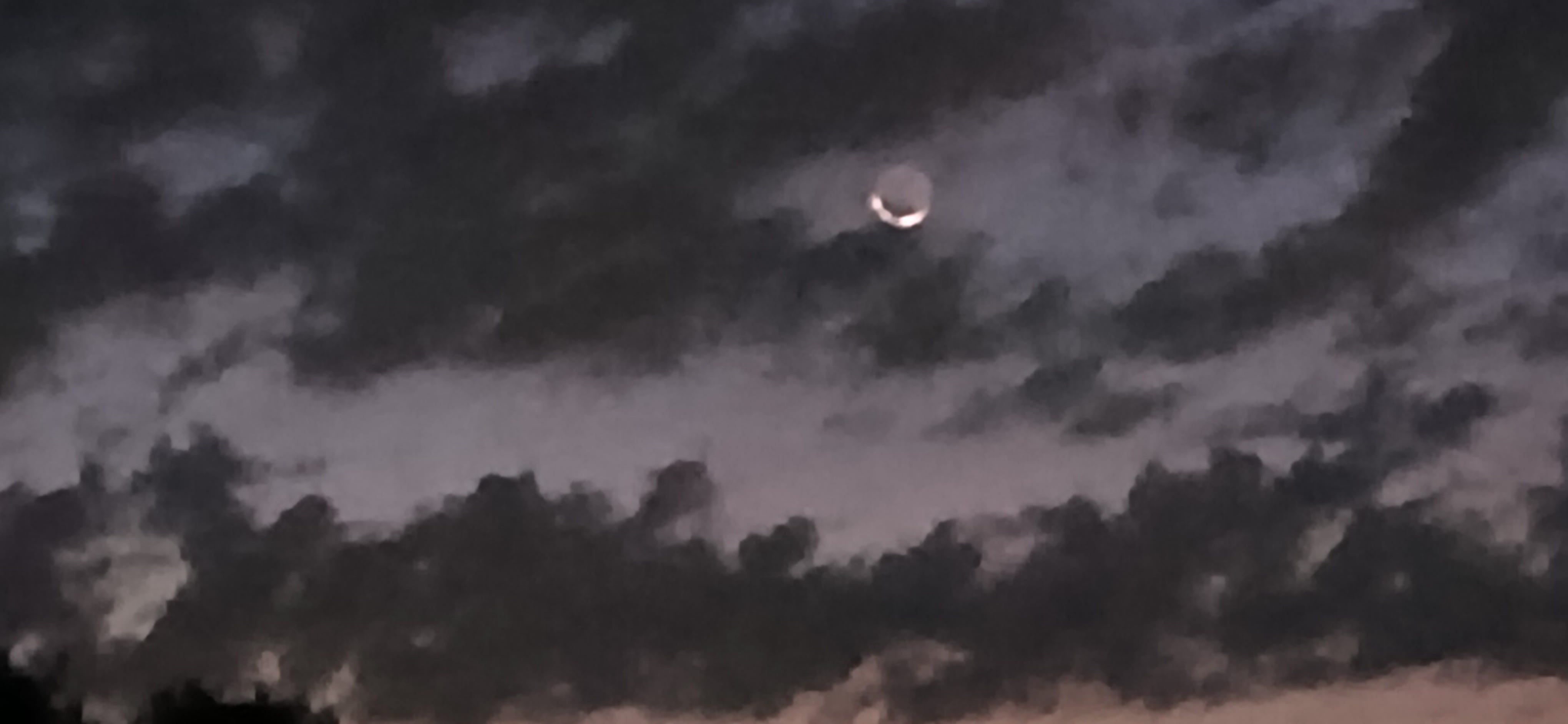
Early this morning, like I'd said yesterday (I think!) would happen, the Moon was lower in the sky, well below Jupiter, and appearing as a crescent as thin as a nail paring.
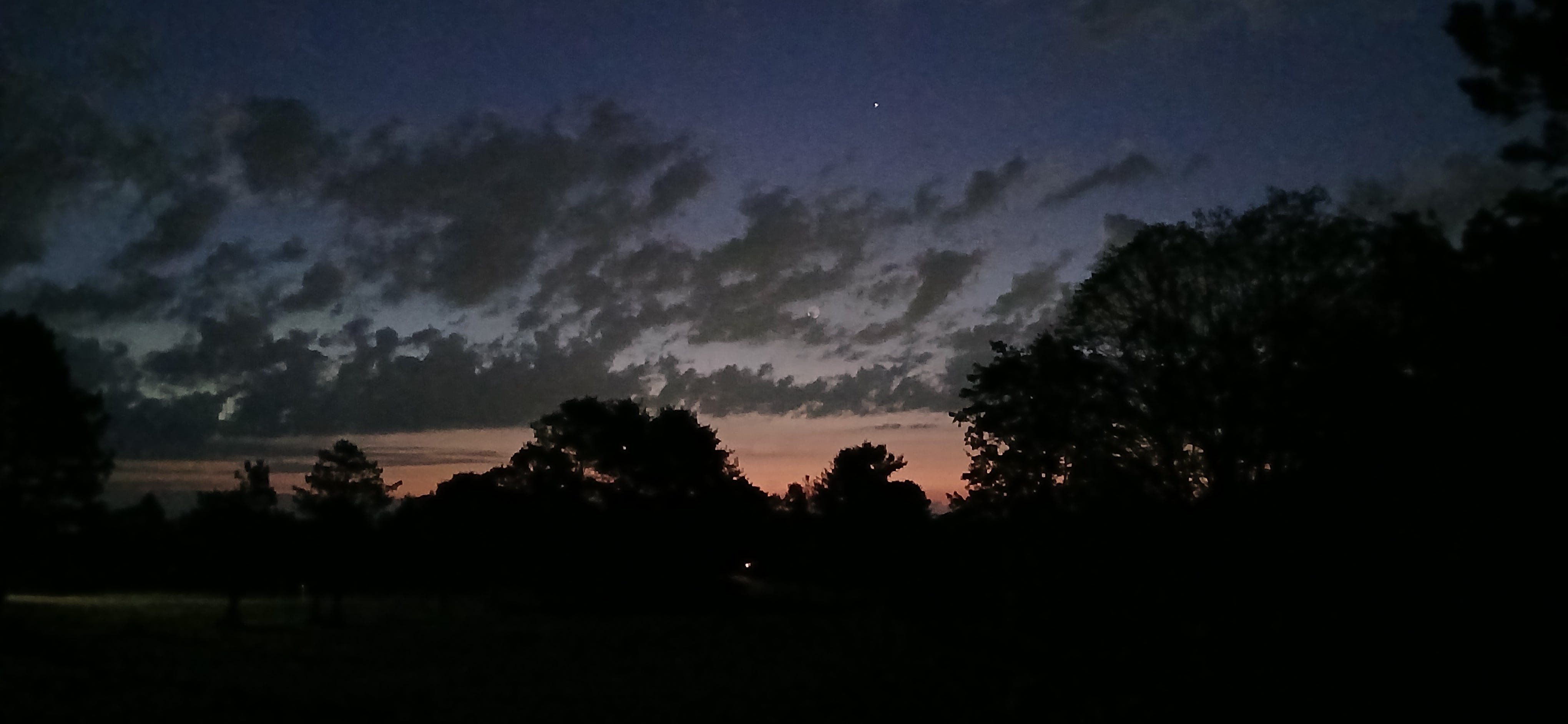
(Jupiter is readily visible above the tattered clouds. The moon is peeking out from among them.)
Tomorrow morning, there will not be a crescent easily seen because Luna will have lumbered slowly Eastward into the Sun's glare. Jupiter will remain in about the same place because its wandering (“Planet” means “wanderer.”) is quite slow in comparison.
The stars, including my beloved constellation of Orion, will remain fixed in the heavens, the time of their appearance in the course of the day determined by where the Sun will be located with respect to them in the calendar. Like the Moon, the Sun has a predictable pattern in the sky, rising and setting daily, but its position with respect to the background stars slowly changing over the course of the months: it speeds around us, but lumbers in the sky more slowly than the Moon.
Now, focusing on the Sun…
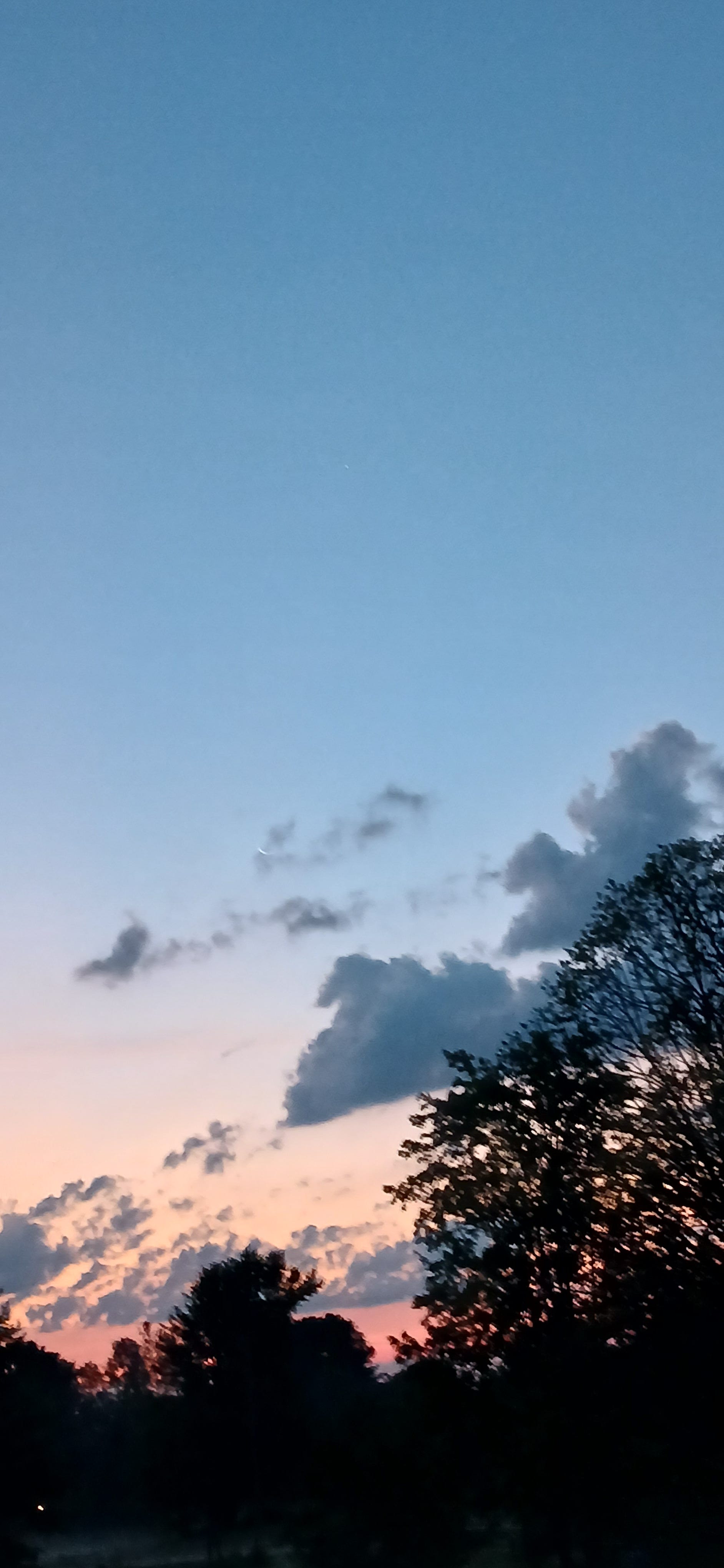
…it's arrival at dawn is heralded by jawdropping colors. Then a yellowish-white brightness all day before it says goodnight with the same color display in reverse.
Man has wondered and theorized about WHAT the Sun is. Perfectly appropriate because God gifted us with intellects to try to understand the Creation that He gave us dominion over, a dominion damaged but not destroyed by Adam's Curse.
The mainstream understanding of the Sun is that it is a ginormous ball of gas, mostly hydrogen, glowing brightly because at its core the hydrogen is fusing into helium.
The other stars are doing likewise with these gas assemblages, and they're all largely arranged in huge, elegant spiral collections called galaxies, the Milky Way, so readily seen in the countryside or wilderness, being pur home galaxy.
Gravity holds all the stars near one another as they orbit the galactic center, and it arranges the galaxies
😀😃😊🥰😍🤩🙂 Ahhhh! Such a beautiful story until…
[LOUD SCRATCHING SOUND]
…common sense problems occur.
First, herding gas molecules is like herding cats 🐈. They will fly apart…quickly. (My niece herded two cats that she raised from kittenhood: they'd flank her as she walked up the driveway. So cute. But so very exceptional.)
Second, gravity is WEAK. When was the last time your broccoli 🥦 rose up to your face from your dinner plate because of gravitational attraction?
Something else must be at work. Since even children can do some fun homework, let's consider this: if the Sun were the size of a grain of sand, its nearest neighbor, Proxima Centauri, would be MILES away! If your broccoli 🥦 won't drift to your head, how, oh how, would a grain of sand be gravitationally connected with another grain miles away???
However, if we consider the electrostatic force — the one that makes your freshly-dried socks stick annoyingly together — we might be onto something. Gravity won't make your socks stick, static will, though.
How so? Well, the electrostatic force is 1,000,000,000,000,000,000,000,000,000,000,000,000,000,000 times stronger than gravity. (That's forty-two zeroes.) It can certainly herd gas molecule cats, and it can certainly connect two grains of sand miles apart! This fact makes for some interesting alternate explanations about stars and galaxies.
Stay tuned.
Our Lady of Guadalupe, lead us to all Truth!
Glory to Jesus Christ, Curious!
I'm familiar with Levi's work. Good man!
And another thing. I find that there are many Catholics who don’t trust their instincts when it comes to recognizing the demonic.
In the Sacred Heart.